One Clear Aim, One Useful Session
A clear session aim helps you choose a fitting practice task and review what happened without tracking every detail or turning practice into a test.
The common mistake in session design is trying to improve everything at once. A learner arrives wanting better timing, cleaner technique, and more confidence, then switches tasks and leaves unsure what changed. A clear practice session aim gives each activity a purpose and makes the review easier.
Why does practice feel scattered?
A broad goal can sound motivating but offer little guidance in the moment. “Get better at guitar” does not tell you whether to work on a chord change, a rhythm pattern, or a whole song. The usual problem is treating a long-term wish as a plan for today.
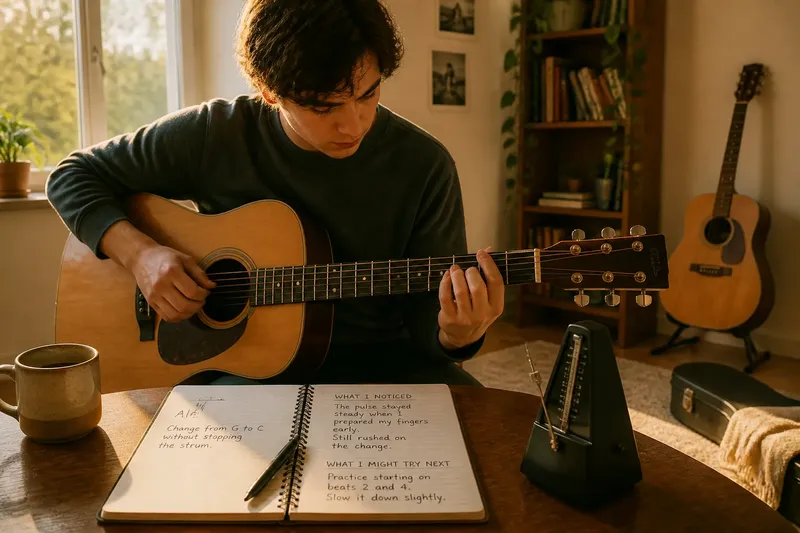
Keep the larger wish, then narrow this session to something you can notice. “Change from G to C without stopping the strum” points toward a task and an observable sign. It does not ask you to judge whether you are a good guitarist.
Try phrasing the aim as an action plus a condition: “Keep the first dance sequence in time while moving through the turn,” or “Explain the main idea of this passage without looking at notes.” The condition gives the action enough shape to guide your choice while leaving room for ordinary variation.
How do you choose a task for a practice session aim?
Choose a task that gives you a chance to notice the aim. If you are working on a specific movement, use a short part of the routine where it occurs. If you are practicing recall, close the book and retrieve one idea instead of rereading a whole chapter.
A task can be too broad, too narrow, or unrelated to the aim. Playing an entire song may bury a troublesome chord change among familiar sections. Repeating one finger movement may remove the musical context that makes the change useful. Think of the aim as a flashlight: it brings one detail into view without making the rest of the room disappear.
Say you are learning to sketch a bicycle and keep losing the shape of the frame. You set the aim, “Connect the two wheels with a frame that reads clearly from across the page.” You draw a few simple outlines, then inspect each one from across the room. If the frame does not clearly link the wheels, you simplify its lines before adding spokes or shading. The observable result is a drawing you can judge against the aim; this invented example illustrates how the task and aim fit together, not a promise that everyone will draw alike.
Before starting, ask whether the task makes the aim visible. If it does, begin; if it does not, adjust the task or clarify the wording. You need a reasonable chance to notice what you chose to practice, not a perfect plan.
Which questions help you adjust a practice session aim?
What if the aim is hard to observe?
Replace a judgment such as “make it feel polished” with a visible action or sound, such as “finish the phrase without losing the beat.” You can still care about polish, but the narrower wording gives you something specific to review.
What if the task feels too easy?
Keep the same aim and add a modest challenge that does not hide it, such as using a new starting point or adding a brief transition. If that makes the original aim hard to judge, choose a simpler variation instead.
What if the session goes badly?
Separate the aim from the outcome: a difficult attempt can still show which part of the task needs attention. Note what interrupted the action; then decide whether to simplify the task next time or clarify the aim.
What if you notice several problems at once?
Write them down for later, but choose one to guide this session. Your notes can preserve useful observations without turning each one into a new assignment.
How can you review without measuring everything?
At the end, return to the exact wording of the aim. Ask what you observed, what made the task easier or harder, and what you would keep or change next time. A short note can capture the useful detail: “The turn stayed in time when I prepared the step early; the entry was still rushed.”
This is a review, not a verdict. You do not need to count every error, rate your mood, and assess technique in the same session. Choose evidence that speaks to the aim. For a music task, that might be whether the pulse continued through a chord change. For language practice, it might be whether you recalled a phrase without prompting.
If the aim was not visible after all, say so plainly. Perhaps the room was noisy, the task included too many parts, or the wording was vague. That is useful information about session design, not a reason to invent a score.
How does one clear aim fit into regular practice?
A single aim is a boundary for one session, not a rule that every session must be narrow in the same way. You can work on a different aspect next time or return to the same aim with a changed task. The point is to know why you chose the activity.
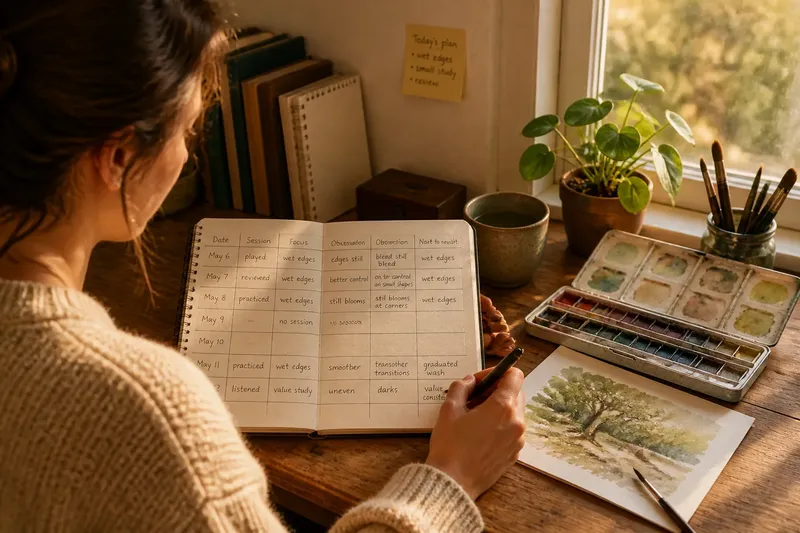
Keep a small record with three prompts: “Aim,” “What I noticed,” and “What I might try next.” A notebook margin or a note on your phone will do. If your notes repeatedly mention the same obstacle, use that pattern to shape a later aim rather than adding more things to track today.
For your next practice session, choose a concrete aim that guides a task and is easy to review honestly. The search phrase practice session aim is useful because it describes this small planning choice: one clear focus gives you a place to look, even while other parts of the skill keep developing.